Bustabit RNG Consistency Report: 100 Million Rounds, Two Halves, One Verdict
Most auditors check a casino once and move on. We split Bustabit's entire 100-million-round hash chain into two halves and asked: Is the RNG consistent from start to finish? Seven statistical tests. One answer.
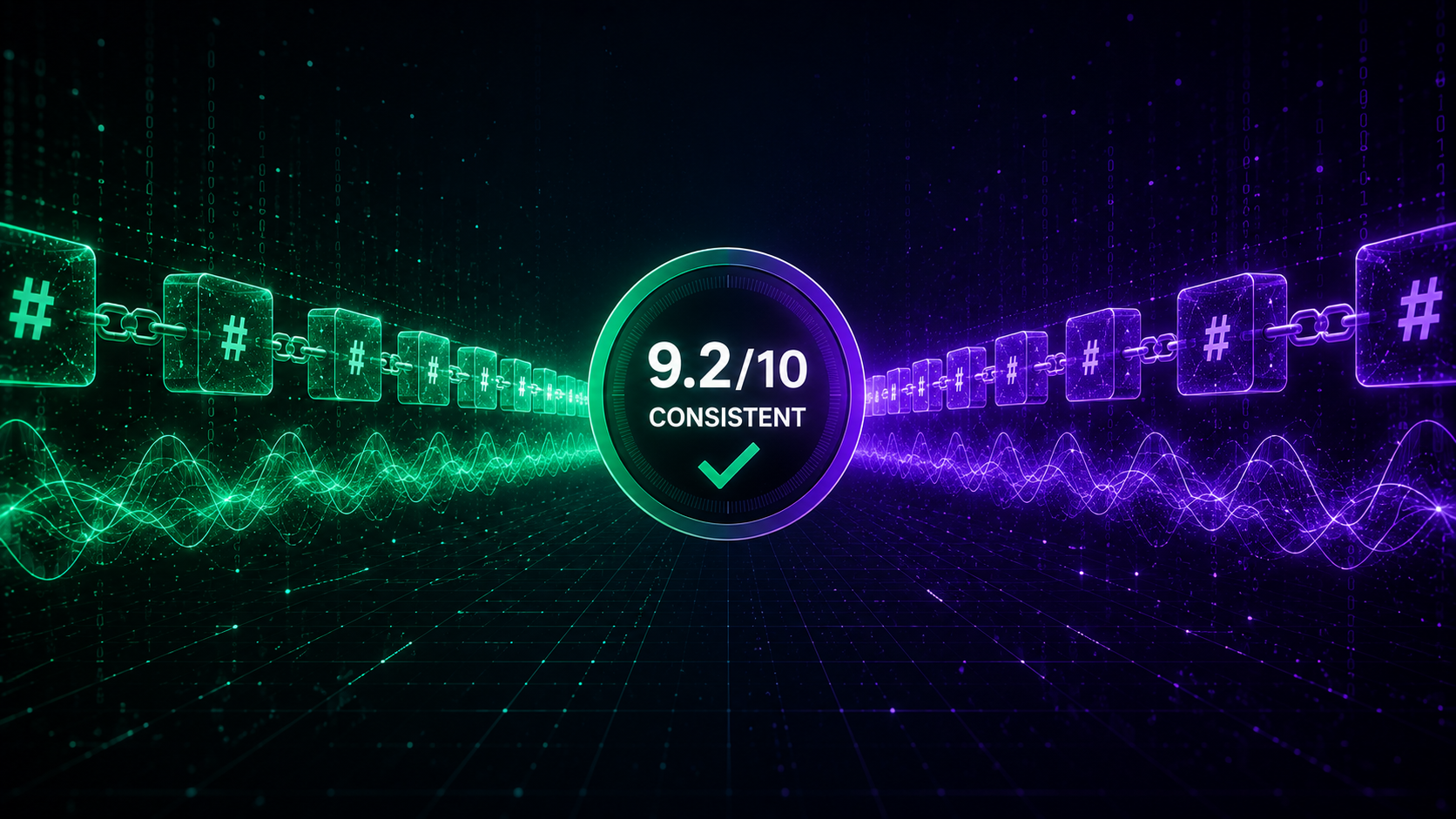
Most provably fair audits check a casino once and call it a day. A green checkmark, a thumbs-up, move on.
We don't work like that.
This is the first published longitudinal consistency report for any crypto casino. We took Bustabit's entire 100-million-round Era 3 hash chain, split it into two halves — 50 million older games vs. 50 million newer games — and asked one question:
Does the RNG behave the same way across the entire chain, or did something change?
If a casino manipulates its RNG partway through a hash chain — even subtly — the statistical fingerprint shifts. Our 11-test comparison framework is designed to catch exactly that.
What We Tested
| Detail | Value |
|---|---|
| Casino | Bustabit (Era 3) |
| Game | Crash |
| Total rounds | 100,000,000 |
| Algorithm | HMAC-SHA256, hash chain (raw bytes) |
| Salt | Bitcoin block hash (...1e08b7fd...) |
| Seeding event | BitcoinTalk #5560454 |
| Sample size per half | 500,000 (every 100th round) |
| Phase A | Games 50,000,001—100,000,000 (older half) |
| Phase B | Games 1—50,000,000 (newer half) |
Original audit: Bustabit Provably Fair Audit Report — 100,000,000 Rounds Analyzed
Why This Matters
A standard provably fair audit verifies that individual hashes are correct. That's table stakes — any calculator can do it.
A consistency report answers a harder question: Is the distribution stable over time?
Here's why that matters:
- A casino could use a perfectly valid HMAC-SHA256 algorithm but choose a biased salt for one segment of the chain
- A hash chain could be partially regenerated after a seeding event if the operator controls the infrastructure
- Subtle distribution drift (e.g., 0.5% fewer high multipliers in newer games) would be invisible to single-hash verification but detectable in aggregate statistics
Our comparison module runs 11 independent statistical tests — each attacking the problem from a different mathematical angle. If the RNG changed behavior anywhere in the chain, at least one test will flag it.
Results: 11/11 Tests Passed
| Test | Result | Statistic | p-Value | Interpretation |
|---|---|---|---|---|
| Two-Sample Kolmogorov-Smirnov | ? PASS | D = 0.00233 | 0.132 | Distributions are statistically identical |
| Chi-Square Homogeneity | ? PASS | ?— = 110.06 | 0.210 | Bin distributions are homogeneous |
| Jensen-Shannon Divergence | ? PASS | JSD = 0.0001 bits | — | Distributions are virtually identical |
| Welch's t-Test | ? PASS | t = -1.167 | 0.243 | Means are statistically equal |
| F-Test (Variance Ratio) | ? PASS | F = 1.002 | 0.425 | Variances are statistically equal |
| Cohen's d (Effect Size) | ? PASS | d = -0.002 | — | Negligible — no practical difference |
| Bhattacharyya Distance | ? PASS | BD = 0.00006 | — | Distributions are virtually identical |
| Mann-Whitney U | ? PASS | z = -1.166 | 0.243 | Rank distributions are identical |
| Anderson-Darling | ? PASS | A— = 1.318 | 0.100 | Tail distributions are identical |
| Cram—r-von Mises | ? PASS | T = 0.046 | 0.901 | Integral CDF distance negligible |
| Energy Distance | ? PASS | E = 0.0000255 | — | Distributions are identical |
Consistency Score: 9.2 / 10 — CONSISTENT
Verdict: RNG output is statistically identical across both halves of the chain. No evidence of manipulation, degradation, or behavioral change.
What the Numbers Mean
Kolmogorov-Smirnov (p = 0.132)
The KS test compares the full cumulative distributions of both halves. A p-value of 0.132 means there's a 13.2% chance of seeing this level of difference between two samples drawn from the same distribution. Perfectly normal. We'd only flag at p < 0.01.
Jensen-Shannon Divergence (0.0001 bits)
JSD measures how much information you'd need to distinguish one distribution from the other. At 0.0001 bits, the answer is: virtually none. For reference, our red flag threshold is 0.01 — this result is 100x below the alarm level.
Cohen's d (-0.002)
Effect size tells you whether a difference is practically meaningful, even if statistically detectable. At d = -0.002, the difference is negligible — you'd need millions of bets to even notice it in your bankroll.
Mann-Whitney U (p = 0.243)
A non-parametric rank-based test that compares whether one distribution tends to produce higher values than the other. Unlike the t-test, it makes no assumptions about the shape of the distribution. p = 0.243 means the ranks are indistinguishable.
Anderson-Darling (p = 0.100)
Similar to KS but with extra sensitivity at the tails of the distribution — exactly where manipulation would show up first. A— = 1.318 is well within normal range.
Cram—r-von Mises (p = 0.901)
Measures the integral of the squared difference between the two CDFs. More sensitive than KS to small, distributed shifts. p = 0.901 is about as clean as it gets.
Energy Distance (E = 0.0000255)
A modern test (Sz—kely & Rizzo, 2004) based on pairwise distances between samples. Can detect any type of distributional difference — location, scale, or shape. At 0.0000255, the distance is essentially zero.
How We Did It
- Collected the full chain: Starting from the most recent game hash, we walked Bustabit's Era 3 hash chain backward through all 100,000,000 rounds. Each crash point was computed using the exact Bustabit algorithm (HMAC-SHA256 ? 52-bit seed ? crash formula).
- Sampled uniformly: Every 100th round was recorded as a raw float (the uniform [0,1) value before crash conversion), giving us 1,000,000 representative samples.
- Split the chain: First 500,000 samples (older 50M games) = Phase A. Last 500,000 samples (newer 50M games) = Phase B.
- Ran the comparison: Our 11-test consistency framework compared the statistical fingerprints of both halves.
Total compute time: 410 seconds for collection + under 5 seconds for the consistency analysis.
Methodology
Full details on our testing framework, including NIST SP 800-22, PractRand, and TestU01 integration: fairplayaudit.com/methodology
Open Source
Every tool we used is publicly available. Verify our results yourself:
- Scorecard Tool: gitlab.com/fairplay-audit/provably-fair-audit
- Consistency Comparator:
src/consistency-comparator.js - Bustabit Collector:
src/bustabit-collector.js
What This Report Does NOT Tell You
Let's be clear about the limits:
- This report confirms statistical consistency across the hash chain. It does not guarantee future behavior if Bustabit switches to a new chain or algorithm.
- Provably fair means the outcomes are verifiable. It does not mean the house edge disappears. Bustabit's 1% house edge is mathematically baked in — that's by design, not manipulation.
- Consistency ? profitability. The RNG is fair. The math still favors the house. Those are two separate facts.
The Bigger Picture: Why Longitudinal Monitoring Matters
Anyone can audit a casino once. We plan to do it continuously.
This Bustabit consistency report is the first in a series. Our roadmap:
- Multi-casino baselines: CryptoGames, Wolf.bet, Bitsler, and more
- Weekly automated monitoring: Fresh data, fresh comparisons, anomaly alerts
- Public watchlist: A live dashboard showing which casinos are consistent — and which aren't
Other auditors tell you a casino was fair on audit day. We tell you it's still fair today.
Report ID: FPA-CONSISTENCY-1781762933375
Generated: June 18, 2026
Auditor: FairPlay Audit (fairplayaudit.com)
Framework: NIST SP 800-22 + PractRand + TestU01 + Custom Consistency Module
More Independent Audits by FairPlay Audit
How We Tested
This report ran Bustabit's Crash game, compared across two independent halves of its hash chain through our full NIST SP 800-22 statistical battery plus our custom game-specific tests, scored on our published 0–10 scale. The exact datasets, seed sources and per-test results are documented in the sections above. These are the same statistical methods that independent gaming labs such as GLI and eCOGRA use to certify regulated casino RNGs.
For the complete framework — all 15 NIST tests explained, plus PractRand, TestU01 BigCrush, ENT and Dieharder, our scoring system and how we handle multiple-testing and dataset-size limits — see Our Methodology. Our toolkit's Community Edition is source-available (BSL 1.1) at gitlab.com/fairplay-audit/provably-fair-audit.