Aviator Predictor Apps Are Scams — Here's the Cryptographic Proof
No Aviator predictor app can do what it promises. Not because we say so — because the cryptography makes it impossible. Here's how the game works and why no outside tool can predict it.

Search for Aviator predictor and you'll find hundreds of apps, Telegram groups, and YouTube videos promising 95% accuracy. Many charge for access. Some even claim to use AI or quantum computing.
Every one of them sells something it can't deliver.
Not because we tested them all — but because the cryptography behind Aviator makes prediction mathematically impossible. This isn't an opinion. It's how the cryptography works. Let me show you exactly why.
How Aviator actually generates results
Before we can explain why prediction is impossible, you need to understand how the crash multiplier is created. Aviator uses a system called provably fair, built on the same cryptographic primitives that secure Bitcoin transactions.
Each round requires four independent inputs:
- Server seed — generated by Spribe before the round. Its SHA-256 hash is published before betting opens, so Spribe commits to it without revealing it.
- Client seed 1 — generated by the first player who places a bet
- Client seed 2 — generated by the second player who places a bet
- Client seed 3 — generated by the third player who places a bet
All four inputs are combined and hashed using SHA-512 to produce the crash multiplier.
Read that again: the result does not exist until three players place bets.
Free challenge · 2 minutes · Real rounds
Think you can beat a predictor? Try it.
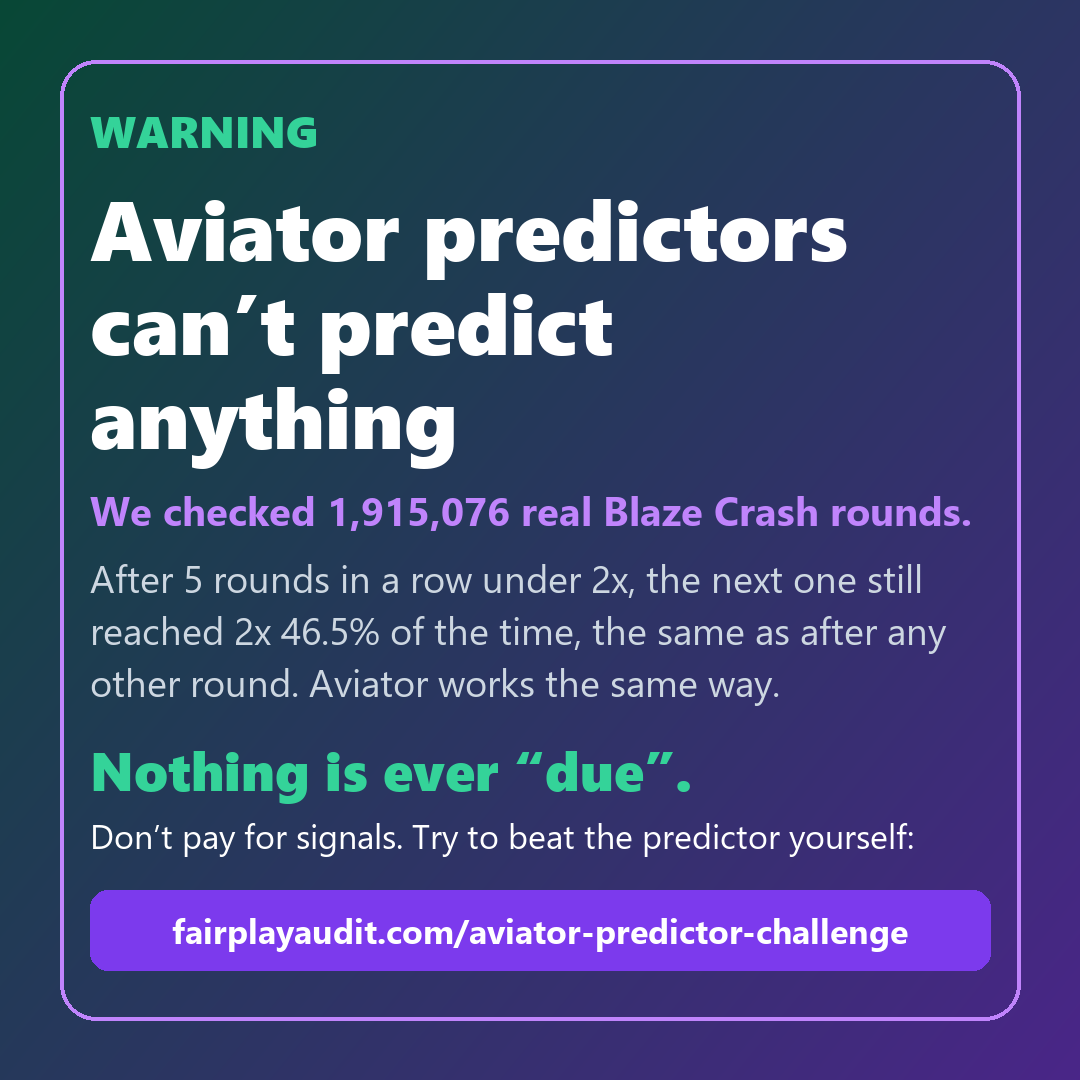
Guess whether the next round reaches 2x, 20 times in a row, with real crash rounds. Then see what 1.9 million rounds say about “patterns”.
Take the Predictor Challenge →Free Tool · No Login · Runs in your browser
Verify an Aviator round yourself
Paste the server seed and the three client seeds from any round’s fairness panel. Our free verifier checks the SHA-256 server-seed commitment and the SHA-512 round hash — nothing is sent to any server.
Open the Aviator Verifier →Why prediction is mathematically impossible
Here's the core problem for any predictor app:
1. The server seed is hidden
Spribe generates the server seed before the round, but only publishes its SHA-256 hash — a one-way function. You can verify the seed after the round, but you cannot reverse-engineer it beforehand. That's the entire point of SHA-256: it's a one-way street.
2. Three client seeds don't exist yet
The client seeds come from the first three players who bet. Before those players click the button, those seeds literally do not exist. No app — no matter how sophisticated — can predict values that haven't been created yet.
3. Hashing wipes out every pattern
SHA-512 scrambles the combined seeds so thoroughly that changing a single character changes the whole result. There is no pattern to carry over from one round to the next, so the last thousand results tell you nothing about the next one. To know the result early you'd need the hidden server seed and the three client seeds — and neither is available before the round.
4. Spribe itself cannot predict it
This is the part most people miss: as long as at least one of those three bets comes from a genuine player, nobody, not even Spribe, can know the result before those three bets are in. Spribe commits to their server seed before the round, but the final computation requires inputs they don't control. This is what makes provably fair fundamentally different from traditional casino RNG — the house doesn't have sole control over outcomes.
The math behind the 3% house edge
So if the game is fair, how does the casino make money?
The edge is built into the formula itself: every multiplier is scaled down by 3%. So whatever target you pick, you get paid 97 cents on the dollar over time. A few percent of rounds end at 1.00x, where every bet loses.
The probability of the plane reaching any multiplier m is:
P(reach m) = 0.97 / m
| Target | Probability | What it means |
|---|---|---|
| 1.5x | 64.7% | Wins roughly 2 out of 3 rounds |
| 2.0x | 48.5% | Coin flip, essentially |
| 5.0x | 19.4% | Wins roughly 1 in 5 |
| 10x | 9.7% | Wins roughly 1 in 10 |
| 100x | 0.97% | Wins roughly 1 in 103 |
No matter which multiplier you target, the expected return is always 97 cents per dollar bet. The 1.5x strategy and the 100x strategy have the exact same expected value. Strategies change your variance (how bumpy the ride is), not your edge (you don't have one).
What predictor scams actually do
If they can't predict outcomes, what are these apps really doing?
- Stealing your money directly — charging for a subscription that delivers random predictions
- Installing malware — APK downloads from unknown sources can contain keyloggers that steal banking credentials, crypto wallets, and personal data
- Affiliate fraud — redirecting you to a casino through their referral link, earning commission on your losses
- Phishing — fake casino sites that look real but steal your deposit
- Data harvesting — collecting your email, phone number, and payment details for resale
Red flags to watch for
- Claims of 90-100% prediction accuracy
- Requires payment in crypto or gift cards
- Screenshots of winning streaks (easily faked)
- Telegram groups with disabled comments
- Urgency tactics: Only 3 slots left! Price doubles tomorrow!
- Claims to use AI, machine learning, or quantum computing
- APK downloads from unknown sources
Common strategies — do they work?
Let's be straight about the popular strategies:
1.5x Auto-Cashout (Conservative): You'll win roughly 65% of your rounds. Feels safe. But the 35% of losses eat your profits over time. Expected return: 97%.
Two-Bet Strategy: One safe bet at 1.5x, one risky bet at 10x. Feels clever. But two bets at 97% expected return is still 97% expected return. You can't add two losing strategies together and get a winning one.
Martingale (Double After Loss): Works until it doesn't. A streak of 7 losses turns a $1 base bet into $128. With a 51.5% chance of losing at 2x, losing streaks aren't rare — they're guaranteed over time.
Pattern Watching: Looking at the history panel for patterns. Each round is cryptographically independent. The seeds don't care what happened last round. This is the gambler's fallacy — the most expensive cognitive bias in gambling.
None of these strategies are wrong — they're just not edges. They're bankroll management styles. Just don't believe anyone who tells you they beat the math.
Can Aviator be independently audited?
This is where it gets interesting — and where we have to be transparent.
At FairPlay Audit, we've audited Bustabit's public hash chain twice — 500,000 rounds through the full NIST suite, then 100 million rounds for RNG consistency — and published audits for Roobet and BC.Game. Those casinos use public hash chains — the entire game history is openly verifiable.
Aviator is different. You can verify individual rounds after they happen, but Spribe doesn't publish a complete round history with seeds. We cannot download and audit 10 million rounds the way we can with Bustabit.
That said, Aviator's system has a genuine architectural strength: three independent client seeds from real players means no single party can steer the outcome, as long as those players are real. That's a stronger multi-party guarantee than most crash games offer.
Spribe says Aviator is certified by independent testing labs, including GLI (Gaming Laboratories International) and iTech Labs. We haven't seen those reports, so we can't tell you exactly what they cover. They aren't public audits like ours.
Our position: We can't audit what we can't access. If Spribe ever publishes a full round history with seeds, we'll run it through the same NIST SP 800-22 tests we use for every casino. Until then, we'll state what's verifiable and what isn't — because honesty is worth more than a fake score.
The bottom line
On paper, Aviator's provably fair design is solid. The 3% house edge is transparent and mathematically provable. No strategy overcomes it.
No predictor app can deliver what it sells — not because we say so, but because the cryptography says so. Save your money. If someone could predict Aviator, they'd have broken SHA-256, the hash function a large part of internet security relies on. They would not be selling signals on Telegram.
If you play anyway, decide on your limit before you start, and treat that money as already gone. And if someone promises you a way to beat the math — they're the ones taking your money, not the casino.
Protect Yourself
Check the Data
See which crypto casinos passed independent statistical audits — with the raw data behind each result. Data, not promises.
View the FairPlay Audit Tracker → Learn to Verify Yourself →Want to see what a full audit looks like? Start here:
- View the FairPlay Audit Tracker — see which casinos we've verified and how
- Bustabit Audit Report — 500,000 rounds, 19 of 20 NIST tests passed
The casino floor teaches you one thing early: the math always wins. The only question is whether the math is fair. That's what we check.
Know someone paying for Aviator signals?
Send them this page. It might save them a lot of money.
Share on WhatsAppShare on TelegramGroups prefer pictures: download the warning card and send it as an image.