13 Ways Crypto Casinos Scam You in 2026 — The Complete Taxonomy
Every documented crypto casino scam type — from exit scams and withdrawal blocking to rigged RNG and nation-state hacks. Real cases, real numbers, zero speculation.
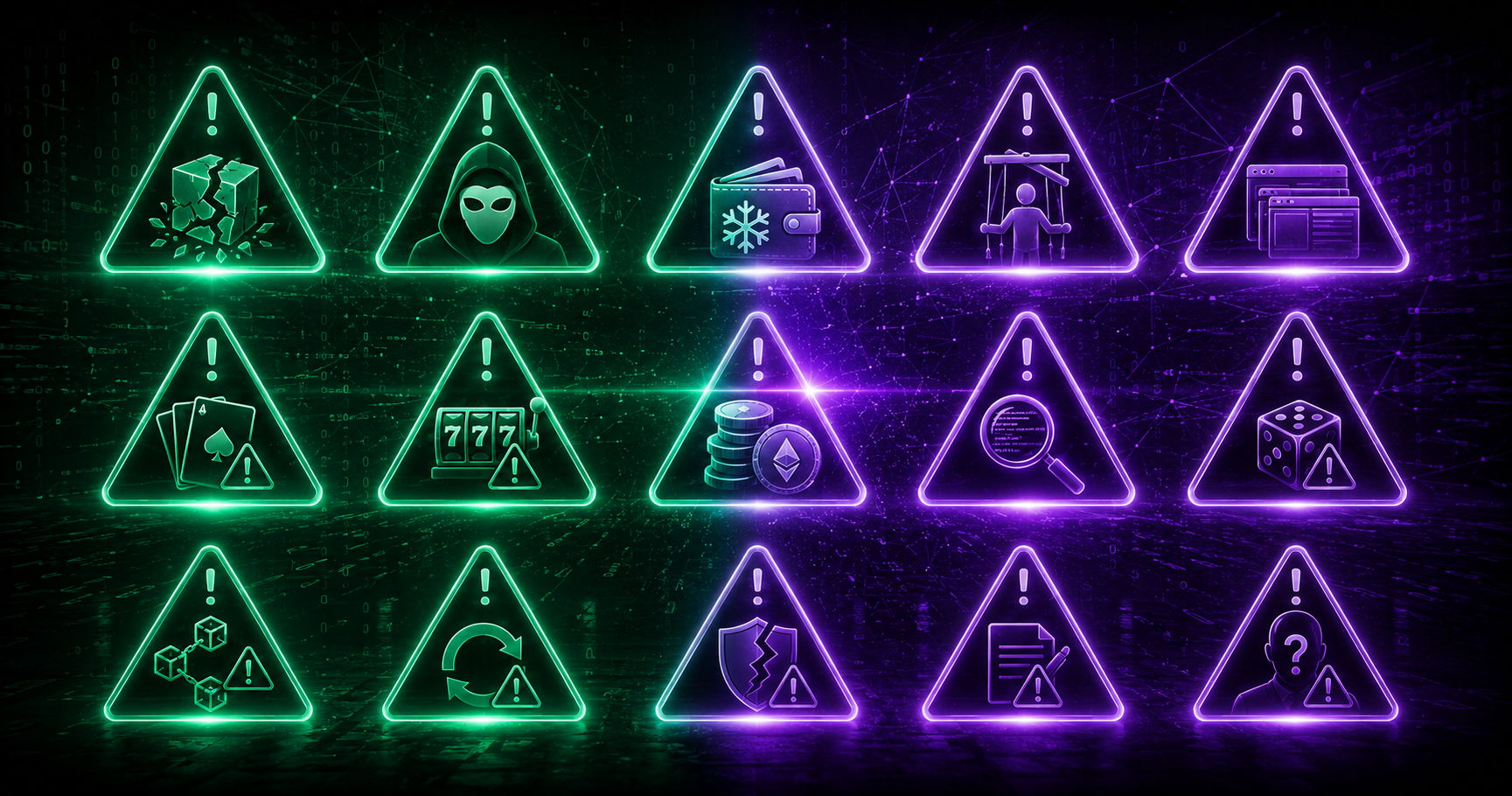
I've worked casino floors for years. I've seen every hustle, every edge case, every manager who looked the other way. And I'll tell you something: the scams happening in crypto casinos right now make the old brick-and-mortar tricks look like shoplifting from a vending machine.
We're talking about $81.4 billion in crypto casino gross gaming revenue in 2024. That much money attracts serious criminals — not guys in tracksuits, but developers, nation-states, and organized crime syndicates with lawyers on retainer.
This article isn't a panic piece. I am not trying to scare you off gambling. I am trying to give you the same briefing I would give a trusted friend before they walked into a casino I had never vetted. Because right now, most players have no idea what they're walking into.
Here are the 13 ways crypto casinos scam you in 2026 — categorized, documented, with real numbers and real cases.
1. Exit Scam / Rug Pull
The operator takes your money and vanishes.
This is the oldest crime in the book, updated for the blockchain era. You deposit funds. The platform runs for months, sometimes years, building trust. Then one day, the website goes dark and the wallets are empty.
The most documented case from 2024: ZKasino.
Players bridged 10,515 ETH — roughly $33 million — to what they were told was a new ZK-based gambling blockchain. A developer named "cygaar" later proved that the "ZK blockchain" was a standard Arbitrum Nitro chain that could be deployed in about two minutes. No Zero-Knowledge technology. No EigenDA. Just marketing.
The developer converted user funds into worthless $ZKAS tokens at $0.055 with a 15-month vesting period. The Dutch financial crimes authority FIOD arrested a 26-year-old suspect and seized €11.4 million in crypto, real estate, and luxury cars. Binance froze additional millions on warrant.
As of 2025 — almost a year later — the ETH has still not been returned.
If you can't independently verify who owns the platform and where it's licensed, you're not gambling. You're donating.
2. Withdrawal Blocking
You win. They simply refuse to pay.
This is the most common complaint I see across forums, Reddit, and player communities. The casino is perfectly happy to take deposits. Withdrawals are a different story.
Rollbit: A player deposited $15,000, played for months with no issues. At withdrawal time, account frozen. Full KYC submitted — passport, proof of address, selfie. Still blocked after two months. Zero explanation.
BC.Game: A player won $42,060. Account locked immediately after KYC submission. Then BC.Game listed all withdrawal methods as "under maintenance" for 90 consecutive days starting February 2026. Not one method available for three months.
Roobet: The average disputed amount on AskGamblers is $11,669. One documented case: $22,379 stuck in "review" for days with no explanation. FinTelegram confirmed that Roobet allows significant gambling without KYC verification — until you try to withdraw.
The pattern is consistent: deposits clear instantly. Withdrawals trigger sudden KYC requests. KYC completion triggers "review periods." Review periods have no end date. I've been in this business too long to believe in that kind of coincidence. We documented the full pattern in our Crypto Casino Withdrawal Scam deep dive.
3. Phantom Jackpot / Advance Fee Fraud
You "won" something you never bet on.
This one borrows from the classic 419 scam. You receive a message — email, Telegram, sometimes a pop-up on a sketchy site — telling you that you have won a jackpot.
SpinMe.club ran this exact scheme. Players were contacted and told they had won a $4 million sports bet. To release the winnings, they needed to pay $1,000 in "taxes" first. The winnings never existed. The $1,000 was the entire point.
The rule is simple: no legitimate casino asks you to pay fees to collect winnings. Ever. If someone tells you that you won something you don't remember entering, you didn't win anything.
4. Influencer Fraud
What you're watching isn't gambling. It's advertising.
I want to be precise here, because this one operates in a gray zone that most players don't understand.
Stake reportedly pays Drake approximately $100 million per year as a brand ambassador. xQc receives $200,000 per gambling stream — regardless of duration or wager size. Trainwreckstv reportedly earned $360 million total from his Stake deal, starting at $1 million per month and peaking at $22.5 million per month.
These streamers aren't gambling with their own money in the way you think. They play with house money, under special agreements, to create content that makes gambling look effortless and profitable.
The real damage: 36 to 47 percent of minors aged 11 to 18 have been exposed to gambling content through these streams. A RICO lawsuit was filed against Drake and Stake in December 2025. Australia's ACMA has started handing out fines of up to AU$2.4 million for influencers sharing links to illegal gambling sites.
When you watch a stream and think "this looks easy" — remember that you're watching a paid commercial with a gambling backdrop. We break down the verification methods in How to Seed-Check Streamer Wins.
5. Clone Casino
A fraudulent copy of a real platform designed to steal your deposit.
B9.GAME is a near-perfect visual copy of BC.GAME. The interface, branding, color scheme, promotional text — all plagiarized. It holds no legitimate license. It accepts deposits normally. Withdrawals are blocked after funds arrive.
Over 75% of its Trustpilot reviews are negative. The platform targets users in Pakistan and other developing markets where verification resources are scarce. BC.Game's legal department is investigating for trademark infringement.
In Mexico, hackers placed casino redirects on compromised government websites — .gob.mx and .edu.mx domains — to lend fake casinos the appearance of state endorsement. Over 68,000 victims were affected.
Before depositing at any crypto casino, verify the exact domain character by character. Check that the SSL certificate matches the expected organization. Confirm the license number on the regulator's website — not on the casino's own page.
6. Fake App / Wallet Drain
You install what looks like a casino app. It empties your wallet.
In 2024, a fake WalletConnect application appeared on the Google Play Store. It was listed for months before removal. During that time, it stole over $70,000 through direct wallet access permissions granted during setup.
The app didn't even need to run a casino. The moment you connected your wallet, the malicious contract drained your funds.
These apps exploit the complexity of wallet permissions and the fact that most users don't read what they're authorizing. A pop-up that says "Allow this app to manage your tokens" sounds routine. It's not.
Stick to platforms accessible through browsers with verified domains. Treat any mobile app for a crypto casino with serious skepticism unless it comes from a major, independently audited platform.
7. Rigged RNG / Provably Fair Manipulation
"Provably fair" doesn't mean fair. It means auditable — if anyone bothers to audit it.
This is the area I spend most of my time on at FairPlayAudit. And it's more complicated than most people realize. I wrote about this at length in Why Provably Fair Doesn't Mean Fair — but here's the short version.
The PrimeDice case is the most documented historical example. The casino's server leaked active, decrypted server seeds across multiple accounts. By exploiting this, a user won approximately 2,400 BTC — close to $1 million at the time. The provably fair system was technically intact. The implementation was broken.
More concerning: a GitHub project called provably_fixed demonstrates how a casino can manipulate seed pre-selection while every individual hash verification check passes. The math is correct hand by hand. The distribution over thousands of rounds isn't. This is exactly what our statistical test suite — NIST SP 800-22, PractRand, TestU01, and custom distribution tests — is designed to catch. A single hand verification can't detect this. You need tens of thousands of rounds and standardized statistical tests.
The seedrandom npm package had a hash collision vulnerability documented at JustCTF 2024. Several smaller casinos used this library for randomness generation.
Every casino claims provably fair. Almost none have been independently tested over tens of thousands of rounds with NIST SP 800-22 statistical tools. We're currently the only operation doing this at scale.
8. KYC Data Theft
They collect your identity documents. Then they sell them.
Know Your Customer verification exists for legitimate compliance reasons. But some operators treat KYC submissions as a secondary revenue stream.
Fixbet leaked KYC data belonging to thousands of players. Government-issued IDs, home addresses, selfie photos — all submitted for identity verification. This data was sold in bulk to identity fraud operators.
In Spain, identity fraud in online gambling jumped from 7% to 18% of all casino fraud cases in one year, with 8,675 complaints filed in 2025 alone.
Before submitting KYC to any crypto casino: verify the operator has a real regulatory relationship, check their data protection policy for specific retention and deletion terms, and never submit documents to a platform you haven't independently verified. Read our guide on What Triggers KYC at Crypto Casinos to understand when and why platforms request your data.
9. Money Laundering Vehicle
The casino isn't scamming players. It's using players as cover to clean dirty money.
RaiseBet24.com was a Malta-licensed casino used by the Sicilian Mafia — Cosa Nostra — to launder $74.2 million. The former Malta Gaming Authority CEO Heathcliff Farrugia was implicated in covering up anti-money-laundering violations at Tumas Group casinos, whose owner was a convicted terrorist.
A Malta license — widely considered a gold standard — didn't prevent this. The operator had regulatory protection at the highest level.
This is why Chainalysis estimated that $82 billion in crypto was linked to money laundering in 2025 — an eightfold increase since 2020. Chinese Money Laundering Networks alone processed $16.1 billion — $44 million per day through 1,799 active wallets. Casinos are a preferred vehicle because gambling transactions are inherently hard to trace and "wins" provide plausible explanations for sudden wealth.
When a casino you play at gets seized in a money laundering investigation, your funds can be frozen as evidence. Your clean money gets caught in the same net as the dirty money.
10. Pig Butchering
They invest months building a relationship. Then they take everything.
A stranger makes contact on social media or dating apps. They build a genuine-feeling relationship over weeks or months. Eventually, they introduce you to a "great casino" or "investment platform." You deposit. You see early "wins" — fabricated in the interface. You deposit more. Eventually, withdrawals are blocked, the platform vanishes, and the contact disappears.
Chainalysis documented that pig butchering accounts for 33.2% of all crypto scam revenue globally. The casino component is often indistinguishable from a legitimate platform visually. The scam is in the relationship, not the software.
No one who cold-contacts you online to share a "great gambling tip" is doing you a favor.
11. Streaming Manipulation
The audience is fake. The wins are staged. The entire ecosystem is theater.
The RICO lawsuit against Drake and Stake.US (December 2025) includes allegations that Drake used Stake.US's internal tipping system to pay streaming bots and view farms to inflate his Spotify play counts. The casino's payment infrastructure was allegedly used to transfer value to fraudulent accounts in ways that obscured the transaction trail.
This matters to you as a player because it reveals how these platforms think about compliance. When a major streamer allegedly uses the casino's own infrastructure for fraud — and the casino maintains the relationship — you learn something about the operator's priorities.
12. Nation-State Hack
Your casino was robbed. By North Korea.
On September 4, 2023, the FBI confirmed that North Korea's Lazarus Group (APT38) stole $41 million from Stake.com. The funds moved through Ethereum, BSC, and Polygon, laundered via Lido, Squid Router, and the Avalanche bridge.
This wasn't isolated. In 2023 alone, Lazarus Group stole over $200 million: $100 million from Atomic Wallet, $60 million from Alphapo and CoinsPaid, and the Stake $41 million.
Stake covered all player losses from reserves and stayed operational. Not every casino can do that. A platform operating on thin margins that suffers a $40 million hack doesn't come back. Your funds disappear with it.
When North Korea is targeting crypto casino infrastructure, "secure" means something different than it does in traditional online banking.
13. Signal Selling / Tip Fraud
They sell you something mathematically impossible.
Search Telegram for "Aviator signals," "Crash predictions," or "Mines strategy guaranteed." You will find hundreds of groups selling subscriptions for $50 to $200 per month that promise to predict provably fair game outcomes.
I need to say this plainly: this is mathematically impossible.
Spribe's Aviator uses a provably fair RNG. The outcome is determined by cryptographic seeds before each round begins. No third party has access to those seeds. No signal group can predict the multiplier. Anyone selling "signals" is either selling fabricated data or running an affiliate scheme where they collect commissions when you lose money. We proved this mathematically in our Aviator Predictor Scam investigation.
Many of these Telegram APKs contain malware that steals login credentials and wallet keys. We documented this extensively in our Telegram Casino Scams article.
Telegram casino scam activity increased by over 2,000% between November 2024 and January 2025. The ecosystem is industrialized. Organized groups operate dozens of channels simultaneously, rotating domains and identities when one gets reported.
If someone on Telegram tells you they can predict a provably fair game outcome, they can't. The math doesn't allow exceptions.
What You Can Actually Do
I am not going to tell you to stop gambling. That's your decision. But here's what I would tell anyone who asked me how to reduce their exposure.
Before you deposit
- Verify the license number directly on the regulator's website — not the casino's own page.
- Search the casino name plus "withdrawal problems" and read actual complaint threads.
- Check for independent statistical audits. Almost no one runs them. We do — see our audit methodology and published reports for Stake, Roobet, and Blaze.
- Start small. Test the withdrawal process with a small amount before depositing serious money.
Verify the math, not the marketing
Provably fair claims are only meaningful if someone has verified them systematically — not one hand at a time, but over tens of thousands of rounds using standardized statistical test batteries. Our suite runs NIST SP 800-22, PractRand, TestU01, and custom distribution analysis across 100,000+ rounds per casino.
That's the difference between checking a receipt and running an audit.
Protect your identity
Only submit KYC to platforms with verifiable regulatory relationships. Read the data retention section before uploading your passport. If there's no clear retention period and deletion policy, your documents stay in their systems indefinitely — and you have seen what happens when those systems get breached.
Ignore Telegram signals
No signal group can predict RNG outcomes. No "VIP strategy group" has insider information on provably fair games. The math doesn't work that way. Anyone telling you otherwise is either ignorant or lying.
Sources
- ZKasino exit scam — CryptoTimes, OKX Learn, CoinTelegraph
- BC.Game insolvency & complaints — NEXT.io, AskGamblers, Trustpilot
- Rollbit withdrawal blocking — Trustpilot, Nerdbot
- Roobet complaints & KYC — AskGamblers, FinTelegram
- Stake/Drake RICO lawsuit — Harvard JSEL, Courthouse News (PDF), CBC News
- Stake.com Lazarus hack — FBI Press Release, TRM Labs, Decrypt
- xQc/Trainwreckstv deals — 15M.com, Tribuna.com
- B9.GAME clone scam — Geekboots, Baltic Review
- Fixbet KYC leak — Webopedia
- RaiseBet24 / Cosa Nostra — SEON
- Crypto money laundering $82B — Chainalysis 2024, Yahoo Finance
- PrimeDice exploit — Medium/@Stunna
- provably_fixed PoC — GitHub: monk-afk
- Operacao Desfortuna (Brazil) — Agencia Brasil
- Spain identity fraud — CoinTelegraph ES
- Market size $81.4B GGR — Nerdbot
Related: The 10-second casino test that review sites won’t show you — how a wallet-extension blocklist flagged a casino that passed every review portal.